
.22 LR velocity: standard, high velocity and quiet loads
A .22 LR box can say standard velocity, high velocity, subsonic or quiet. Those are useful labels, but the exact load matters more than the category name. The best choice depends on your firearm, what you are shooting and how reliably that ammunition runs in your setup.
Three CCI loads with real numbers
CCI's published table lists 40-grain Standard Velocity part 0035 at 1,070 FPS, 40-grain Mini-Mag part 0030 at 1,235 FPS, and 40-grain Quiet-22 part 0960 at 710 FPS. These are muzzle figures from the manufacturer's catalog, not readings from your rifle or pistol. All three are .22 Long Rifle, but the 710-FPS Quiet-22 is a very different proposition from a 1,235-FPS Mini-Mag.
CCI also lists a separate Quiet-22 Semi-Auto load, part 975CC, with a 45-grain bullet at 835 FPS. That distinction matters. The standard Quiet-22's reduced power may not cycle every semiautomatic action; CCI specifically describes Quiet-22 Semi-Auto as a load intended to operate most autoloading .22s. Check the exact package and your firearm manual rather than assuming all 'Quiet' boxes act alike.
For a casual range day
Standard Velocity is a sensible starting point for target work when your firearm runs it well. Mini-Mag may be worth trying if a particular semiauto prefers a higher-velocity load or you want to compare a plated round-nose option. Quiet-22 can appeal to someone using a bolt-action rifle or revolver where automatic cycling is not a requirement. Range rules and safe handling still apply to every one of them; a quieter cartridge is still a firearm discharge and still calls for hearing protection.
For someone buying their first brick, a small box of each candidate load is a better experiment than assuming a favorite from another firearm will behave the same. Record group size, feeding and extraction in your own setup. If a round sounds or feels abnormal, stop and have the firearm checked before continuing.
About the word subsonic
The speed of sound varies with conditions, so a single FPS cutoff should not be treated as a universal product specification. CCI discusses subsonic rimfire in terms of reducing the sharp crack associated with crossing that threshold, but its load-specific labels and numbers are still the right place to start. A box advertised as 'standard velocity' should be evaluated by its exact part number, not silently relabeled because its listed number looks close to a generic cutoff.
A manufacturer's catalog figure also does not guarantee the speed from your barrel. If quiet operation is important to you, compare ammunition in the same firearm and environment while following all range and local rules. Never substitute reduced-noise marketing for proper eye and ear protection.
Keep the packages straight
CCI sells .22 LR in several package sizes. The part number, bullet type and count distinguish one offer from another. Read the listing's package information before comparing price per round; a 50-round box, 100-round box and bulk container should not be treated as identical listings. Browse current .22 LR ammunition and check the exact product page before ordering.
The semiauto question
A blowback-operated .22 semiautomatic relies on the cartridge producing enough energy to cycle its action. That is why the difference between CCI Quiet-22 0960 and Quiet-22 Semi-Auto 975CC is more than a name. CCI describes the latter as designed to operate most autoloading .22s, while the very low-velocity 0960 is commonly considered for manually operated actions and revolvers. 'Most' is not 'every': try the exact load in your firearm, and stop if it fails to cycle or anything sounds unusual.
A beginner with a bolt-action rifle can usually tolerate a wider range of cycling behavior because they operate the action themselves, though they still must follow the firearm manual and range rules. Someone using a semiauto for a full day may care more about dependable cycling than the quietest possible box. That is a good reason to buy a test box before a bulk container.
A better way to compare value
Price per round is useful only after the exact package and load are confirmed. A Mini-Mag 100-round box and a Standard Velocity 50-round box can have a similar-looking price while delivering different quantities and purposes. If your objective is economical target practice, include reliability in your calculation: a cheaper cartridge that repeatedly interrupts the session may not be the best value for that firearm.
Velocity can also vary by lot, temperature and barrel. If you want to measure it, use a chronograph and record those conditions with the part number. If you simply want a load for an afternoon of plinking, the group on paper and the way it runs in your firearm may tell you more than a single advertised FPS figure.
Products mentioned and related picks
Current in-stock listings. Check each product page for the exact load, package and availability.
 CCI 22 LR Shotshell 12 Shot Ammo.22 Long RifleView product →
 CCI Ammunition Hunting, 22 LR, 40 Grain, Segmented Hollow Point, 970.22 Long RifleView product →
 Eley Biathlon Club 22 LR 40gr RN.22 Long RifleView product →
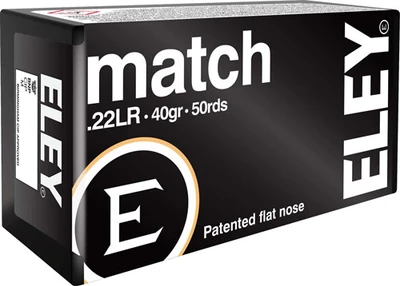 Eley Match 22 LR 40gr EPS.22 Long RifleView product →
 Eley Team 22 LR 40gr EPS.22 Long RifleView product →
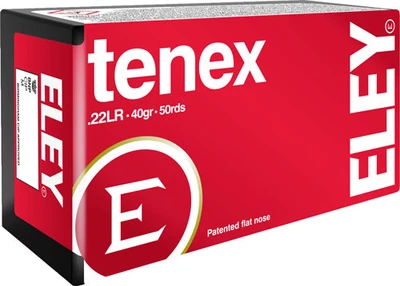 Eley Tenex 22 LR 40gr EPS.22 Long RifleView product →
 Eley Tenex Biathlon 22 LR 40gr Flat Nose.22 Long RifleView product →
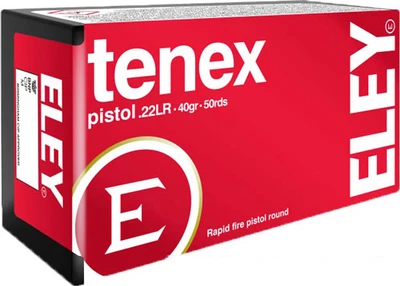 Eley Tenex Pistol 22 LR 40gr Round Nose.22 Long RifleView product →
Keep reading
- Your first range day: what to bring and what to expect
- Indoor vs. outdoor ranges: how to prepare for each
- Hollow-point ammunition: why the bullet designs differ
- How to read an ammunition box: grain, FPS, energy, and more
- Range safety: the habits that matter every visit
- 9mm bullet weights: 115, 124 and 147 grain explained
- How to read a shotgun shell box before you buy
- FMJ vs. JHP ammunition: choosing for the job
- Hunting vs. target rifle ammunition: what changes?
- Shotgun shot sizes and gauges: what fits the hunt or the range