
9mm bullet weights: 115, 124 and 147 grain explained
If you shop 9mm often, you have seen 115, 124 and 147 grain on the shelf. That number is the bullet's weight, not the powder charge. It tells you something about the load, but it does not tell the whole story. Velocity, bullet design, pressure and your own handgun all matter.
What the weight changes
A grain is a unit of mass: one seven-thousandth of a pound. Within one cartridge family, a heavier bullet is often loaded to a lower muzzle velocity, but you should check the actual product table instead of making that a rule. Speer's 2026 Gold Dot table gives a clear same-line example from a 4-inch barrel: 115-grain 23614GD at 1,210 FPS, 124-grain 23618GD at 1,150 FPS and 147-grain 23619GD at 985 FPS. Those numbers describe three distinct factory loads.
Do not compare speed by bullet weight alone across unrelated brands or pressure classes. Speer's 124-grain +P 23617GD is listed at 1,220 FPS from the same test barrel. Its pressure marking matters just as much as its weight, and your firearm maker's instructions determine whether +P ammunition is suitable.
For regular range practice
A 115-grain FMJ is common and often competitively priced in larger boxes. A 124-grain FMJ gives you another familiar practice weight. A 147-grain load is worth trying if you want to see how a heavier bullet feels or where it prints in your handgun. None of those weights is automatically more accurate in every firearm. A useful test is to shoot small, clearly labeled groups with each load under the same conditions and keep the box from the one you prefer.
If your range limits projectile or case materials, those rules come before your preferred weight. FMJ, JHP and other bullet types are different questions from bullet mass. For practice, pick a load that the range permits and that runs reliably in your firearm before buying a case.
For a specific hollow-point load
Two 124-grain JHP boxes can have different bullet construction and velocity. Bonded Speer Gold Dot, Barnes solid-copper XPB and Hornady's tipped designs are not interchangeable simply because their weights look close. If the role is defensive, look at the exact manufacturer's part number, pressure marking and published tests, then confirm that the load functions reliably in your own firearm. A bullet-weight preference by itself is not a test result.
Short barrels can change actual velocity and point of impact compared with published test barrels. Hornady explains why measured speed can differ from a box figure. Treat factory FPS as a comparison under stated conditions, not a promise that every handgun will produce that exact reading.
The simplest way to choose
Start with the cartridge marked on your firearm, then choose a bullet type for your use and a weight you can test. If price and volume are your priorities, compare common FMJ boxes by price per round and availability. If you are evaluating a specific hollow point, compare exact SKUs, not broad weight categories. Record what you shot; that small note is more valuable than a blanket '115 versus 124' argument.
A fair side-by-side range test
Buy one small box of each candidate load before committing to a case. Confirm all boxes say 9mm Luger and are permitted by your range. Shoot each on a fresh, clearly labeled target at the same distance, preferably in similar light and with the same grip and pace. Record feeding, extraction, the group's location and the feel of the recoil. A tighter group from one afternoon is useful, but repeat the comparison before calling it a permanent verdict.
If your handgun is sighted with a particular load, a different weight can strike a different point on the target. That matters more to some shooters than a modest FPS difference in a catalog table. Save the lot number if you find a load you plan to buy repeatedly, and note whether a later lot behaves the same way. The goal is a load you can buy, shoot and trust in your own firearm.
What the factory table does and does not rank
The Speer numbers in this guide are useful because the three standard-pressure Gold Dot loads share a manufacturer line and a stated 4-inch test barrel. They still differ in bullet weight and potentially in point of impact. Their listed muzzle energies are 374, 364 and 317 foot-pounds for 115, 124 and 147 grains respectively. That does not mean the 115-grain bullet is automatically the best defensive choice. Construction, impact speed, test medium and reliable function matter, and a different firearm may yield different velocity.
Products mentioned and related picks
Current in-stock listings. Check each product page for the exact load, package and availability.
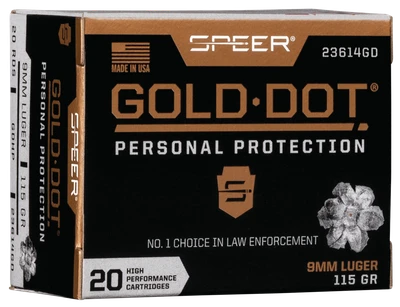 Speer Ammunition Speer Gold Dot, Personal Protection, 9mm, 115 Grain, Hollow Point, 23614GD9mm LugerView product →
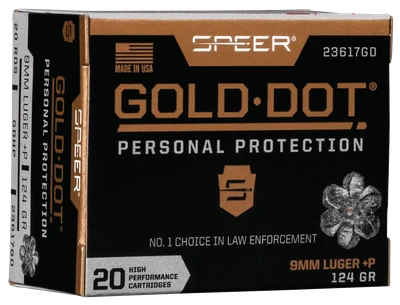 Speer Ammunition Speer Gold Dot, Personal Protection, 9mm, 124 Grain, Hollow Point, +P, 23617GD9mm LugerView product →
 Speer Ammunition Speer Gold Dot, Personal Protection, 9mm, 124 Grain, Hollow Point, 23618GD9mm LugerView product →
 9mm Luger +P 68 Grain Xtreme Defender9mm LugerView product →
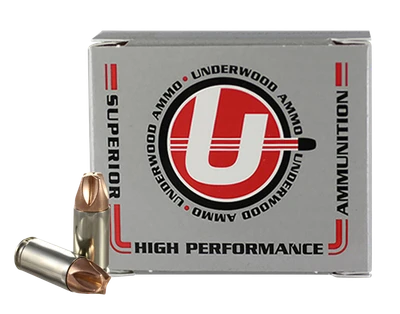 9mm Luger +P 90 Grain Xtreme Defender9mm LugerView product →
 9mm Luger +P+ 115 Grain Jacket Hollow Point Ammo9mm LugerView product →
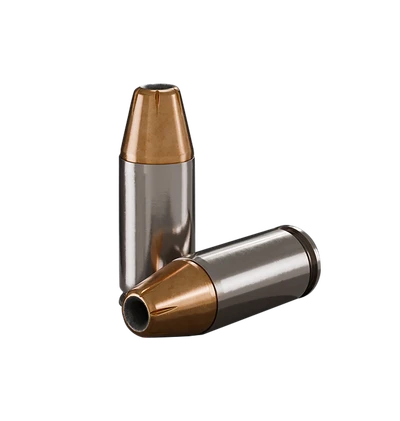 9mm Luger +P+ 124 Grain Jacket Hollow Point9mm LugerView product →
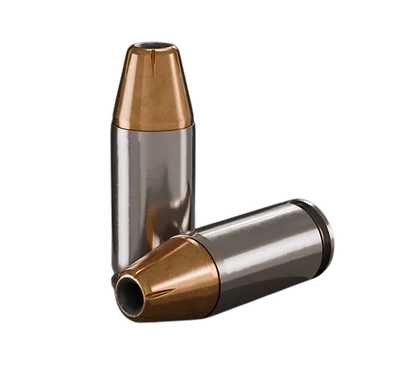 9mm Luger +P+ 147 Grain Jacketed Hollow Point9mm LugerView product →
Keep reading
- Your first range day: what to bring and what to expect
- Indoor vs. outdoor ranges: how to prepare for each
- Hollow-point ammunition: why the bullet designs differ
- How to read an ammunition box: grain, FPS, energy, and more
- Range safety: the habits that matter every visit
- .22 LR velocity: standard, high velocity and quiet loads
- How to read a shotgun shell box before you buy
- FMJ vs. JHP ammunition: choosing for the job
- Hunting vs. target rifle ammunition: what changes?
- Shotgun shot sizes and gauges: what fits the hunt or the range