
Hunting vs. target rifle ammunition: what changes?
The cartridge stamped on the barrel is only the beginning of a rifle-ammunition choice. Two loads in the same cartridge can use bullets built for very different jobs. A target load is judged by consistency on paper; a hunting load also has to be chosen for lawful game, impact conditions and the projectile's intended behavior.
Keep the cartridge exact
Start with the complete chamber designation and your firearm manual. Similar names are not a substitute for compatibility guidance. Then read the bullet weight and construction. FMJ, open-tip match, soft point, bonded, monolithic copper and expanding tipped hunting bullets are different designs. A 'match' label says something about a product's intended precision role, not that it is automatically suited to hunting.
Hornady presents ELD Match as a consistency-focused match bullet and ELD-X as a hunting bullet designed to expand over a range of impact velocities. That difference in intended behavior matters more than a similar-looking tip or a comparable ballistic coefficient. Another maker may use different construction, so verify the exact load rather than applying one company's product story to another's box.
For paper and steel
If your main goal is to practice, a reliable factory FMJ or other range-approved target load may be the economical choice. If you are measuring small groups, a match line may justify its price through more consistent components and bullet design. But the result still has to be tested in your rifle. A premium box cannot guarantee that your rifle will prefer it to a less expensive load.
Record the exact part number, bullet weight, group size, distance, rifle and conditions. Keep the targets or photographs. That gives you a way to compare a candidate at the next trip without pretending that one manufacturer's advertised group is a promise for your rifle.
For hunting
Choose ammunition designed for the game, environment and local rules. The bullet's expansion and penetration characteristics matter, but so do your rifle's accuracy with that load and the likely impact distance. A hunting bullet designed to work at reduced impact velocity may make sense for one scenario; a different projectile may be chosen where a different performance window is expected. Follow the manufacturer's stated use and your jurisdiction's requirements.
Published muzzle FPS is only a starting point. Velocity falls as a bullet travels, and the impact velocity is what an expanding design actually encounters. A ballistic table can help you understand that change, but only when it belongs to the exact load and test conditions. Do not use a generic cartridge-average FPS as if it described the hunting box in your cart.
Where to spend your money
For a customer who shoots mainly at a range, spend on a dependable practice load and enough boxes to learn what the rifle likes. For a hunter, budget for enough of the chosen hunting load to confirm point of impact and function before the season. If you switch between target and hunting ammunition, check your zero with each one; the same caliber does not mean the same trajectory in your rifle.
Browse rifle ammunition by the exact cartridge on your firearm. Read the product page for bullet construction and part number, and use manufacturer data to settle any uncertain specification before you buy.
The same rifle, two different boxes
A .308 Winchester owner might buy a reasonably priced FMJ box for general practice, a match load for testing small groups and a purpose-built expanding hunting load for the field. Those boxes share a cartridge designation but are not replacements for one another. The match bullet may have excellent consistency on paper while lacking the terminal behavior intended by the hunting bullet. The hunting load may print at a different point of impact than the practice load.
A 6.5 Creedmoor shooter faces the same kind of choice. Hornady's ELD Match and ELD-X are a helpful manufacturer example because the company explains the distinct design goals of each line. That does not mean every ELD-X product suits every animal or local rule. The exact cartridge, bullet weight and product page still matter.
How to read the ballistic table honestly
Start with the manufacturer's exact SKU and note its test-barrel length, muzzle FPS and published values at distance. A bullet that starts fast will lose speed as it travels; the pattern depends on its shape and environment. Ballistic coefficient is a useful aerodynamic descriptor, but it is not a simple hunting-grade score. For an expanding bullet, the maker's stated impact-velocity window and actual use case matter too.
If a storefront does not show a trustworthy FPS value for the exact load, leave that field empty and use the manufacturer's page. Generic FPS copied from another weight or bullet type can lead someone to make the wrong comparison. For a serious purchase, ask us to verify a missing specification rather than guessing from a near match.
Products mentioned and related picks
Current in-stock listings. Check each product page for the exact load, package and availability.
 22 Nosler 70gr RDF (Match Grade Ammunition).22 NoslerView product →
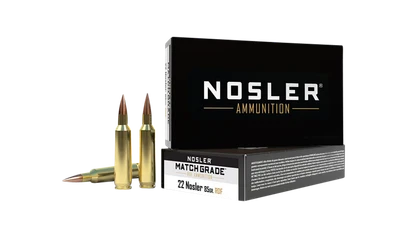 22 Nosler 85gr RDF HPBT Match Grade Ammo (20 ct.).22 NoslerView product →
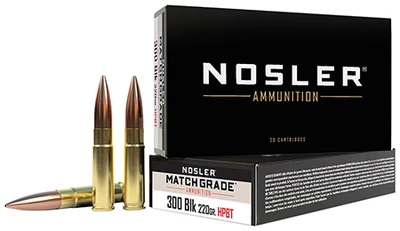 300 AAC Blackout 220gr Custom Competition Match Grade Ammo (20 ct.).300 AAC BlackoutView product →
 45-70 Govt 300gr Soft Point USA 250TH.45-70 GovernmentView product →
 6mm Creedmoor 105gr RDF HPBT Match Grade Ammunition (20 ct.)6mm CreedmoorView product →
 7.62x54R Match 174gr HPBT 207.62x54RView product →
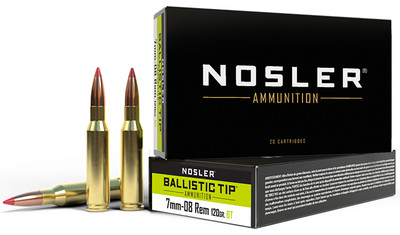 7mm-08 120gr Ballistic Tip Hunting Ammo (20 ct.)7mm-08 RemingtonView product →
 Aguila 22-250 Rem. 60gr Soft Point.22-250 RemingtonView product →
Keep reading
- Your first range day: what to bring and what to expect
- Indoor vs. outdoor ranges: how to prepare for each
- Hollow-point ammunition: why the bullet designs differ
- How to read an ammunition box: grain, FPS, energy, and more
- Range safety: the habits that matter every visit
- 9mm bullet weights: 115, 124 and 147 grain explained
- .22 LR velocity: standard, high velocity and quiet loads
- How to read a shotgun shell box before you buy
- FMJ vs. JHP ammunition: choosing for the job
- Shotgun shot sizes and gauges: what fits the hunt or the range